
Dating tips
October 29, 2026
Gaslighting in a Relationship: What It Is, the Signs and How to Protect Yourself


“You’re making it all up.” “That never happened.” “You’re far too sensitive.” If phrases like these come up in your relationship again and again, and after every conversation you trust your own memory a little less, you may be dealing with gaslighting. It is a form of psychological pressure in which one person gradually convinces the other that they are perceiving reality wrongly. It rarely looks like open aggression: everything happens quietly, consistently and under the guise of care, which is exactly why it is so hard to recognize from the inside. In this article we explain what gaslighting is in simple terms, how to spot it, which phrases a gaslighter uses most often and how to protect yourself — both in a couple and while you are still getting to know someone online.
What Is Gaslighting in Simple Terms
The term comes from Patrick Hamilton’s 1938 play “Gas Light” and its famous 1944 film adaptation starring Ingrid Bergman. The heroine’s husband secretly dims the gas lamps in the house, and when she notices the light fading, he assures her she is imagining it. In the same way he “loses” her belongings and insists she misplaced them herself. Step by step, the woman begins to see herself as careless, forgetful and, in the end, unwell. That is exactly the mechanism the word describes, and the gaslighting meaning is simple: manipulation aimed at making a person doubt their own feelings, memories and conclusions so that they become easier to control.
Psychologists classify gaslighting as a form of emotional abuse. The key feature is that it is systematic. A single argument in which you and your partner remember the same event differently does not mean manipulation: everyone’s memory is selective, and that is normal. We talk about gaslighting when your version of events is denied again and again, you are always the one who is “wrong”, and every attempt to discuss a problem ends with you once again turning out to be the guilty party.
How Gaslighting in Relationships Develops Over Time
Gaslighting in relationships almost never starts on day one. At the beginning the person may be attentive, generous with compliments and very engaged in your conversations. The manipulation appears later, once there is already an attachment between you and you have something to lose. American psychoanalyst Robin Stern of the Yale Center for Emotional Intelligence describes, in her book “The Gaslight Effect”, three stages that a person caught in such a relationship usually goes through.
Stage One: Disbelief
At first the strange moments seem accidental. Your partner denies what they said, and you assume they simply forgot or phrased it badly. You are still sure of your memory, so you argue, give reasons and remind them of details. This is the stage at which it is easiest to get out of the situation, yet it is the one most often missed: everything looks like an ordinary misunderstanding that is not worth “making a drama” about. Trust the feeling that something is off, even if you cannot yet explain exactly what.
Stage Two: Defense
The arguments become more frequent and more exhausting. You are no longer just disagreeing — you are trying to prove that you are fine: rereading messages, recalling witnesses, replaying conversations in your head before you fall asleep. At the same time you start wanting to earn your partner’s approval, so you give in even when you feel you are right. There is less and less energy left for your own life, friends and work, and the mood of your whole day depends on how your partner is feeling.
Stage Three: Depression
At the final stage the person accepts someone else’s version of reality as their own. They genuinely believe they are too emotional, inattentive or “difficult”, apologize endlessly and are afraid to make decisions without their partner’s approval. Anxiety, apathy and sleep problems often follow. Friends and family may notice that the person has changed, but they themselves explain everything by their own shortcomings rather than their partner’s behavior. Leaving this state without outside support is especially hard.
8 Signs of Gaslighting Worth Paying Attention To
A single situation proves nothing, so look for a repeating pattern. Signs of gaslighting usually appear together: denial goes hand in hand with belittling, and belittling with shifting the blame. If you recognize three or four points from the list below, and they happen not once a year but every week, that is a serious reason to take an honest look at your relationship from the outside or to talk it through with someone you trust.
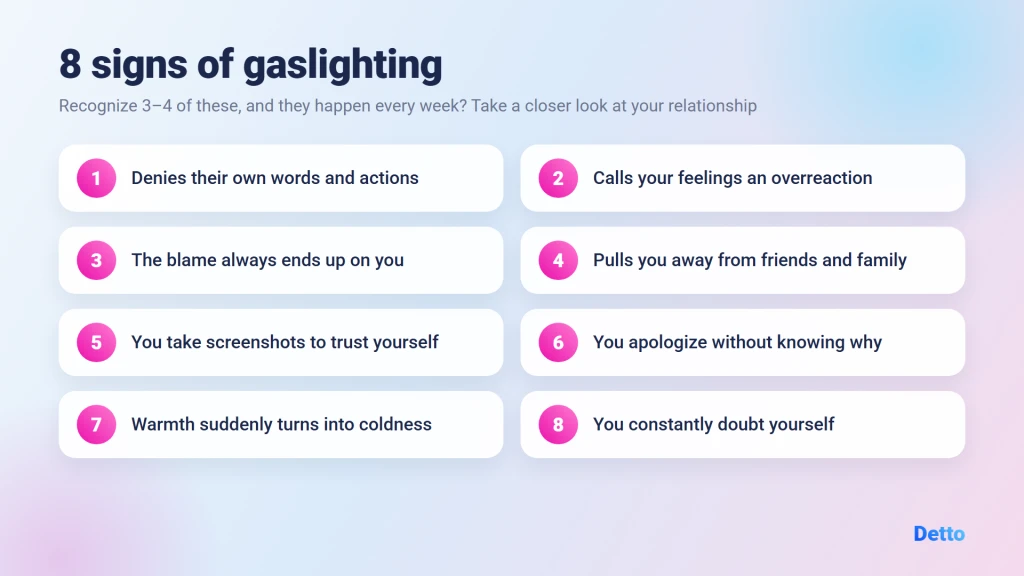
Here is what to watch for first of all:
- your partner denies their words or actions, even when you remember them word for word;
- your feelings are regularly called an overreaction, and you are called too sensitive;
- every conversation about a problem ends with you being the one to blame;
- your partner claims that friends and family are turning you against them and advises you to see them less;
- you have started recording conversations or taking screenshots because you no longer trust your memory;
- after arguments you apologize even when you do not understand what for;
- warm, “perfect” periods suddenly switch to coldness for no visible reason;
- you feel confused and doubt yourself more and more often, although you used to be a confident person.
It is important to look not only at your partner’s behavior but also at your own state. If around this person you are constantly tense, check every word before you say it and are afraid to ask an extra question, that is already a signal, even when specific episodes seem minor. Healthy relationships can be difficult, but in them you do not have to prove every day that you are in your right mind or apologize for your own feelings.
Gaslighting Phrases: What Manipulation Sounds Like
A gaslighter rarely shouts or makes open threats. Far more often they speak in a calm, even caring tone, which makes their words easy to take as sincere advice. Gaslighting phrases share one goal: to shift the conversation from their behavior to your “flaws” — your memory, your emotions, your character. Below are typical formulations worth learning to recognize. They can come from a man or a woman: gaslighting has no gender.
The most common phrases that gaslighting hides behind:
- “That didn’t happen, you’re making things up again”;
- “You overreact to everything”;
- “I was joking, you have no sense of humor at all”;
- “You drove me to it”;
- “Nobody but me will tell you the truth”;
- “You do realize something is wrong with you?”;
- “There you go with your fantasies again, you’re just tired”.
On its own, each of these phrases can also be heard in a healthy couple — for example, in the heat of an emotional argument. It becomes worrying when they turn into the main way to end any conversation. A useful rule: notice what happens after such words. If every time you give in, apologize and drop your question, while the problem itself stays unsolved, the manipulation is working exactly as intended.
How to Deal With Gaslighting
Learning how to deal with gaslighting is hard, because the manipulation strikes at the very confidence you need to defend yourself. So the goal at first is not to win the argument but to get your footing back: your own facts, your own feelings and the support of the people around you. A partner who manipulates deliberately usually cannot be persuaded by logical arguments — they have no interest in you being right, so endless discussions only drain you further.
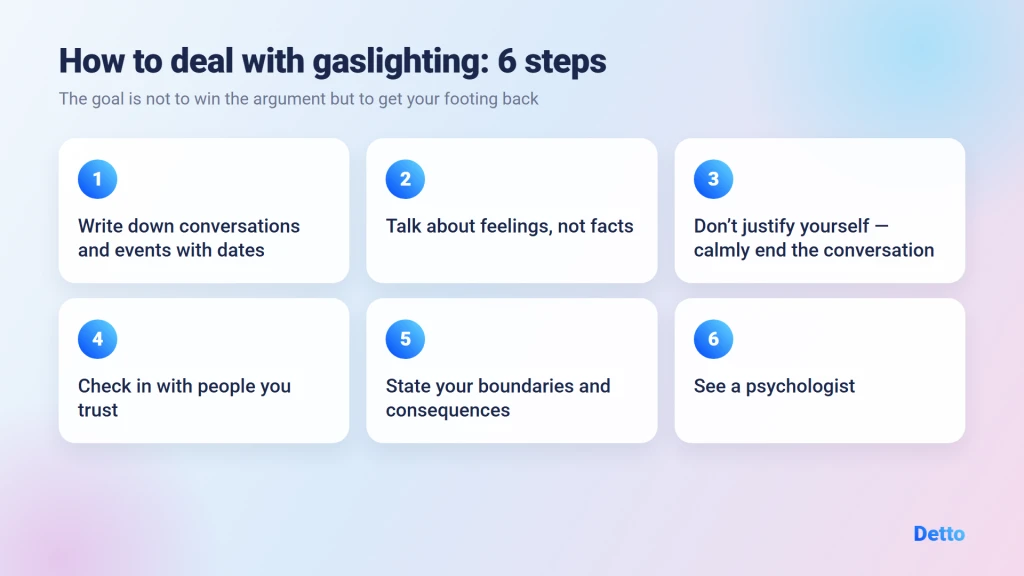
These steps will help you keep a clear head:
- Write down important conversations and events with dates — a diary helps you trust your memory.
- Talk about your feelings rather than facts: “it hurt me” is impossible to deny.
- Do not justify yourself or try to prove you are fine — it is enough to end the conversation calmly.
- Check in with people you trust: an outside view restores your sense of reality.
- State your boundaries and the consequences: “If you call me crazy again, I will leave.”
- See a psychologist — a specialist will help you rebuild your self-esteem and make a decision.
If the pressure turns into threats, control over money, stalking or physical aggression, do not stay alone with it. In the US, the free, confidential National Domestic Violence Hotline is available 24/7 at 1-800-799-7233 (you can also text START to 88788), and in immediate danger you should call 911. If you are in another country, contact your national domestic violence hotline or the local emergency number. A consultation does not commit you to anything, but it helps you see the situation clearly and work out your next steps.
Gaslighting vs Abuse: What Is the Difference
The two terms are often confused, although they are not identical. Abuse is the broader phenomenon: any violence in a relationship, including physical, economic, sexual or psychological. Gaslighting is one of the tools of psychological abuse, and one of the most insidious, because it leaves no visible marks. That is why gaslighting and abuse so often go together: a person who doubts their own perception is less likely to notice other forms of control as well. We have written in more detail about what toxic relationships look like and how they differ from ordinary quarrels in a separate article with 15 signs.
How to Spot a Gaslighter While Dating Online
The first signals are often visible already in your messages. The person denies what they wrote a few days ago, and when you quote the message, they reply “you misunderstood”. They may delete their messages after a disagreement, joke about your feelings in the very first week or suddenly take offence when you ask an ordinary follow-up question. Another warning sign is haste: trying to move the conversation to another messenger as quickly as possible and asking about personal details. These and other red flags in online dating are easier to notice when you take your time and look at behavior, not just words.
The advantage of meeting online is that you have time to get a feel for someone before the first date. On the Detto dating site profiles show interests and dating goals, and the match rate tells you how closely your answers in the compatibility test line up. Before a date you can talk on a video chat and hear how the person reacts to ordinary questions. If someone belittles your opinions or twists your words right from the start, you owe them nothing: calmly end the conversation and look for people whose company gives you energy rather than taking it away.
Conclusion
Gaslighting is dangerous because it works unnoticed: for a long time a person believes that they are the problem, not their partner’s behavior. That is why the best protection is to know what it looks like, to trust your own feelings and not to be ashamed to ask for help. If you recognized your situation in this article, that is no reason to blame yourself. It is a reason to stop, talk to people close to you or a psychologist, and remember: in a healthy relationship you do not have to prove every day that your reality is real.
Read also: